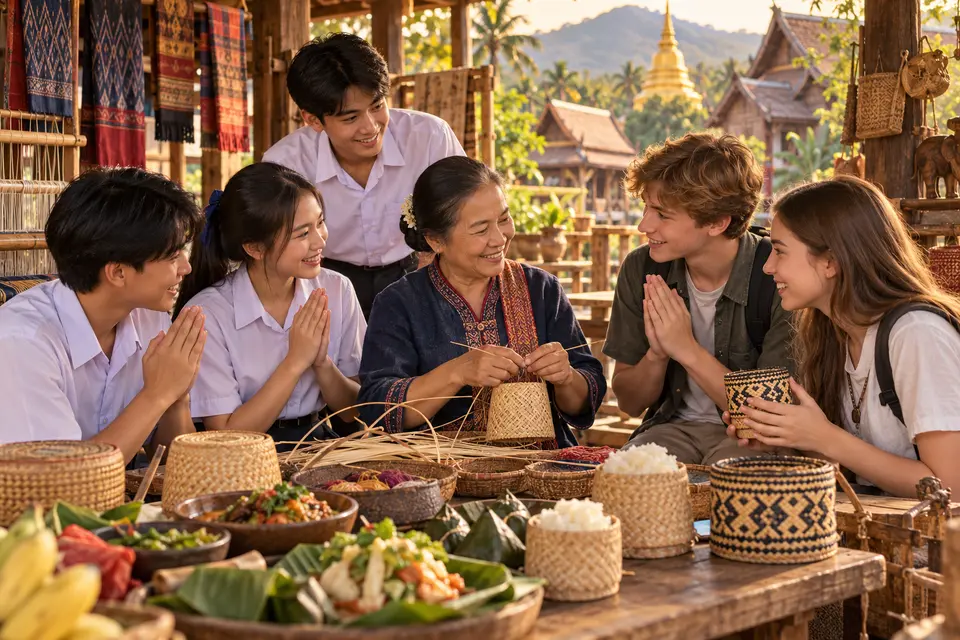
Today
Your goal
- I can explain a Thai custom or tradition in clear everyday English.
- I can compare cultural practices without saying one is better.
- I can respond politely when a visitor is confused about a custom.
?
Listen to the English first. Use slower audio only when needed, then repeat it yourself.
Learn
Key words
In Thailand, people often …
Introduce a common practice carefully.
Thai help
ในประเทศไทย ผู้คนมักจะ…อิน ไทย-แลนด์ พี-เพิล ออฟ-เฟิน
ใช้แนะนำสิ่งที่พบได้บ่อยโดยไม่เหมารวม
It’s common to …
Describe a practice that is often seen.
Thai help
เป็นเรื่องปกติที่จะ…อิทส์ คอม-เมิน ทู
ใช้อธิบายสิ่งที่พบได้บ่อย
In some families, …
Limit a statement to some families.
Thai help
ในบางครอบครัว…อิน ซัม แฟม-อะ-ลีซ
ใช้จำกัดข้อความว่าเป็นเพียงบางครอบครัว
This tradition is connected with …
Explain the meaning behind a tradition.
Thai help
ธรรมเนียมนี้เกี่ยวข้องกับ…ดิส ทระ-ดิช-เชิน อิซ คะ-เน็ก-ทิด วิธ
ใช้อธิบายความหมายหรือที่มาของธรรมเนียม
It’s similar to …
Compare a cultural practice respectfully.
Thai help
มันคล้ายกับ…อิทส์ ซิม-อะ-เลอร์ ทู
ใช้เปรียบเทียบสิ่งที่คล้ายกันอย่างให้เกียรติ
One difference is …
Point out one difference without judging.
Thai help
ความแตกต่างอย่างหนึ่งคือ…วัน ดิฟ-เฟอ-เรินซ์ อิซ
ใช้บอกความแตกต่างโดยไม่ตัดสิน
People used to …
Describe a common past practice.
Thai help
คนสมัยก่อนมักจะ…พี-เพิล ยูสด์ ทู
ใช้พูดถึงสิ่งที่คนเคยทำในอดีต
Nowadays, …
Contrast a present-day practice.
Thai help
ปัจจุบัน…นาว-อะ-เดย์ซ
ใช้เปรียบเทียบกับปัจจุบัน
It depends on the situation.
Show that customs can vary.
Thai help
ขึ้นอยู่กับสถานการณ์อิท ดี-เพ็นดซ ออน เดอะ ซิท-ชู-เอ-เชิน
ใช้ย้ำว่าธรรมเนียมอาจแตกต่างตามสถานการณ์
There isn’t only one way to …
Avoid presenting one practice as universal.
Thai help
ไม่ได้มีวิธีเดียวในการ…แดร์ อิซ-เซินท์ โอน-ลี วัน เวย์ ทู
ใช้หลีกเลี่ยงการเหมารวมว่ามีวิธีเดียว
Listen & Use
Use it
Real-life English
In Thailand, people often choose a greeting based on age and situation.
Thai help
ในประเทศไทยคนมักเลือกวิธีทักทายตามอายุและสถานการณ์
Tip: Stress often; avoid saying always.
It’s common to follow local signs and observe respectful behaviour at a temple.
Thai help
โดยทั่วไปควรทำตามป้ายและสังเกตพฤติกรรมที่สุภาพในวัด
Tip: Pause after common to.
In some families, younger people use special respect terms for older relatives.
Thai help
ในบางครอบครัว คนอายุน้อยใช้คำเรียกให้เกียรติญาติผู้ใหญ่
Tip: Keep some families clear.
Nowadays, large Songkran events are common, but family traditions remain important too.
Thai help
ปัจจุบันงานสงกรานต์ใหญ่พบได้บ่อย แต่ธรรมเนียมครอบครัวยังสำคัญ
Tip: Stress nowadays and family traditions.
Listen
Useful sentences
Thai meaning
ในประเทศไทยผู้คนมักทักทายผู้ใหญ่ด้วยความสุภาพ แต่การทักทายที่แน่นอนขึ้นอยู่กับสถานการณ์
Thai meaning
สงกรานต์คล้ายเทศกาลปีใหม่อื่นในบางด้าน แม้ธรรมเนียมท้องถิ่นต่างกัน
Thai meaning
คนสมัยก่อนอาจฉลองบางธรรมเนียมในชุมชนมากกว่า ปัจจุบันงานใหญ่สาธารณะก็พบได้บ่อย
Thai meaning
ไม่ได้มีวิธีเดียวในการแสดงความเคารพในครอบครัวไทย
Thai meaning
ธรรมเนียมนี้เกี่ยวข้องกับครอบครัว ชุมชน และประวัติศาสตร์ท้องถิ่น
Listening for meaning
A visitor asks about Thai customs
Listen twice. First identify purpose and main point. Then note important details, certainty/viewpoints, and the outcome before opening Thai help.
- Why is the visitor worried?
- What does the student say about the wai?
- What does Songkran show about cultural variety?
Visitor: I’m staying with a Thai family this weekend, and I’m worried I’ll do something rude. Do I need to wai every person I meet? Student: Not necessarily. In Thailand, people often wai older people or someone they want to greet respectfully, but it depends on the situation. With friends of the same age, people may just smile or say hello. Visitor: My guidebook says I should never touch anyone’s head. Is that always true? Student: It’s a useful caution, especially with people you don’t know well, but there isn’t only one way to behave. It’s better to notice personal boundaries and ask if you are unsure. Visitor: We’re also visiting a temple. What should I remember? Student: Dress respectfully, follow the signs, speak quietly, and watch what local visitors are doing. Some temples have specific rules, so don’t assume every place is identical. Visitor: What about Songkran? Is it only a water fight? Student: Public water celebrations are very visible, but in some families Songkran is also connected with visiting relatives, showing respect to older people, or religious activities. Visitor: That sounds more varied than I expected. Student: Exactly. Thai customs can differ by family, region, generation, and situation. If you’re respectful and willing to ask, people will usually understand that you’re learning.
คำช่วยภาษาไทยหลังลองตอบ: นรินช่วยนักเรียนแลกเปลี่ยนเตรียมตัวไปพักกับครอบครัวไทย เขาอธิบายว่าคำแนะนำวัฒนธรรมควรใช้แบบไม่เหมารวม การไหว้ การเรียกญาติ มารยาทในวัด และสงกรานต์อาจแตกต่างตามอายุ ครอบครัว ภูมิภาค และสถานการณ์ คำแนะนำหลักคือสังเกต ถามอย่างสุภาพ และไม่พูดว่าคนไทยทุกคนทำเหมือนกัน
Reading for meaning
Reading: Thai Culture and Cultural Comparison
Read in English first. Identify purpose, main idea, evidence/details, and the language function for this week before opening Thai help.
- Why does Narin avoid saying that every Thai person follows the same rule?
- What are two examples of customs that may vary by situation or family?
- How does the text recommend responding when you are unsure?
- What similarity can exist even when cultural behaviour looks different?
นรินช่วยนักเรียนแลกเปลี่ยนเตรียมตัวไปพักกับครอบครัวไทย เขาอธิบายว่าคำแนะนำวัฒนธรรมควรใช้แบบไม่เหมารวม การไหว้ การเรียกญาติ มารยาทในวัด และสงกรานต์อาจแตกต่างตามอายุ ครอบครัว ภูมิภาค และสถานการณ์ คำแนะนำหลักคือสังเกต ถามอย่างสุภาพ และไม่พูดว่าคนไทยทุกคนทำเหมือนกัน
Use it
Listen, then change the details
Do I need to wai every person I meet?
Thai meaning
ฉันต้องไหว้ทุกคนที่เจอไหม
In Thailand, people often wai older people, but it depends on the situation.
Thai meaning
ในประเทศไทยคนมักไหว้ผู้ใหญ่ แต่ขึ้นอยู่กับสถานการณ์
Is it rude if I just smile at someone my age?
Thai meaning
ถ้าฉันยิ้มให้คนอายุเท่ากันเฉย ๆ จะเสียมารยาทไหม
Not usually. With friends, a smile or hello can be completely normal.
Thai meaning
โดยทั่วไปไม่ เพื่อนวัยเดียวกันยิ้มหรือทัก hello ก็ปกติได้
My guidebook says Songkran is a water festival. Is that the whole tradition?
Thai meaning
หนังสือบอกว่าสงกรานต์คือเทศกาลเล่นน้ำ นั่นคือทั้งหมดไหม
Public water events are common, but in some families Songkran is also connected with relatives and religious activities.
Thai meaning
การเล่นน้ำสาธารณะพบได้บ่อย แต่บางครอบครัวสงกรานต์ยังเกี่ยวกับญาติและกิจกรรมทางศาสนา
So Thai families all celebrate differently?
Thai meaning
งั้นครอบครัวไทยทุกครอบครัวฉลองต่างกันใช่ไหม
There isn’t only one way to celebrate. Region, family, age, and situation can all matter.
Thai meaning
ไม่ได้มีวิธีฉลองแบบเดียว ภูมิภาค ครอบครัว อายุ และสถานการณ์ล้วนมีผล
That helps. I’ll observe and ask instead of assuming.
Thai meaning
เข้าใจแล้ว ฉันจะสังเกตและถามแทนการคิดเอง
Exactly. Respectful questions are usually better than stereotypes.
Thai meaning
ใช่ คำถามที่ให้เกียรติมักดีกว่าการเหมารวม

Try / Speak
Respectful culture explainer
Prepare briefly, speak independently, respond to other people, and use notes only as prompts rather than reading full sentences.
Connected writing
Explain a Thai custom to a visitor
Write a respectful cultural explanation. Describe the custom, give context, compare carefully, and include a sentence that avoids overgeneralising.
Target: 90–110 words
- I used connected ideas rather than isolated sentences.
- I included specific evidence, detail, or an example.
- My final message matches the real-world purpose.
Mediation challenge
Bridge a cultural misunderstanding
A visitor thinks a Thai student was unfriendly because the student did not wai. Explain that greetings vary by age, relationship, place, and situation, and also acknowledge why the visitor felt confused.
A wai can show respect, but not every interaction requires one. Friends may smile or say hello. The visitor expected a wai because of advice they had read.
การไหว้สามารถแสดงความเคารพ แต่ไม่ใช่ทุกสถานการณ์ต้องไหว้ เพื่อนอาจยิ้มหรือทัก hello ผู้มาเยือนคาดว่าจะได้รับการไหว้เพราะคำแนะนำที่เคยอ่าน
Reflect
How independently did I communicate?
- I used cautious language instead of making absolute cultural claims.
- I compared practices without saying one culture was better.
- I answered questions respectfully and admitted when a practice depends on the situation.
Check
Quick check
More help
Can-Do goals
By the end of this lesson, I can…
- Spoken InteractionI can explain a Thai custom or tradition in clear everyday English.
- Language ControlI can compare cultural practices without saying one is better.
- MediationI can respond politely when a visitor is confused about a custom.
CEFR Pre-B1 → B1
Skill focus
Clear, respectful cultural explanation with no stereotyping.
Thai Learner Focus
Explain culture with respectful stress and clear /r/–/l/
Clear /r/ and /l/ where relevant; respectful pronunciation of Thai names; stress in explanation.
รี-สเพ็กท์ เดอะ โล-เคิล คัส-เทิม
Keep /l/ clear in local and stress LO-.
อิท ดี-เพ็นดซ ออน เดอะ ซิท-ชู-เอ-เชิน
Stress the key content words; do not rush Thai place or festival names.
More words
English for familiar situations
wai
Thai help
การไหว้
A visitor asks when a wai is appropriate.
temple manners
Thai help
มารยาทในวัด
At a temple, explain respectful clothing and behaviour without assuming every place has identical rules.
Songkran
Thai help
สงกรานต์
Songkran can involve family traditions as well as public water celebrations.
Loy Krathong
Thai help
ลอยกระทง
Explain Loy Krathong as a tradition that may be celebrated differently in different places.
family respect terms
Thai help
คำเรียกให้เกียรติในครอบครัว
Thai family language often shows age and relationship, but usage depends on the family.
northern Thai customs
Thai help
ธรรมเนียมภาคเหนือ
Northern Thai customs can differ from customs in other regions.
Grammar help
Comparatives, used to / usually / tend to, relative clauses, and softened generalisations
Use comparatives to describe similarities and differences. Use used to for past habits, usually/tend to for common patterns, relative clauses for extra information, and many people/often/in some families to soften generalisations.
More practice
- Explain one Thai custom using many people/often/in some families instead of always.
- Compare one Thai practice with another culture without ranking them.
- Answer two visitor follow-up questions and use It depends on the situation when appropriate.